






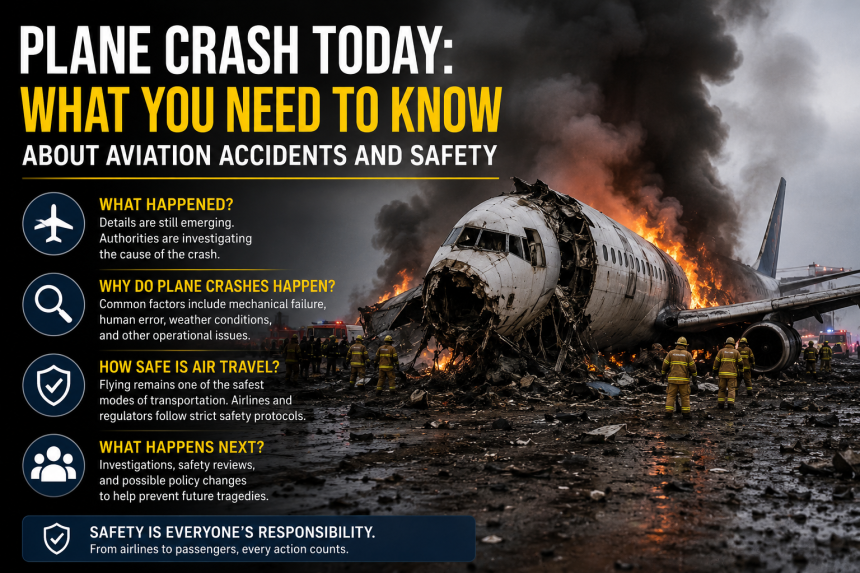
Every time the words “plane crash today” start trending online, millions of people rush to their phones and computers looking for answers. It is a natural human reaction. Flying feels different from driving a car or riding a train, because once you are in the air, you have no control over what happens next. That feeling of helplessness is exactly why news about a plane crash spreads so fast and why it grabs so much attention, even when the actual risk of flying remains extremely low.
In this article, we will look at why plane crash news spreads so quickly, how aviation accidents are actually investigated, what the real statistics say about flight safety, and what steps you can take as a passenger to feel more confident every time you board a flight.
Why “Plane Crash Today” Searches Spike So Often
If you search for “plane crash today” on any given day, you will almost always find something, whether it is a small private aircraft making an emergency landing, a military training accident, or a commercial flight diversion. This is not because flying has become more dangerous. It is because:
- Aviation is a massive global industry. Tens of thousands of flights take off every single day around the world, ranging from tiny two-seater planes to giant commercial jets carrying hundreds of passengers. With that much air traffic, minor incidents such as hard landings, aborted takeoffs, or mechanical issues happen somewhere in the world almost daily.
- News travels instantly. Unlike decades ago, a small plane accident in a rural area can now be reported, shared, and searched within minutes thanks to smartphones, social media, and 24-hour news cycles.
- Aviation accidents are emotionally powerful stories. Human beings are wired to pay close attention to dramatic, high-stakes events. A car accident rarely makes national news, but a plane incident almost always does, even if nobody was seriously hurt.
- Search engines reward trending topics. Once a story starts gaining traction, related searches multiply, and news aggregators pick it up, creating a cycle that keeps the topic near the top of search results for hours or even days.
How Plane Crash Investigations Actually Work

One of the most reassuring things about aviation is how seriously accidents are investigated, no matter how small. In most countries, a dedicated government agency is responsible for figuring out exactly what went wrong.
- In the United States, this is the National Transportation Safety Board (NTSB).
- In the United Kingdom, it is the Air Accidents Investigation Branch (AAIB).
- Most other countries have similar civil aviation safety bodies, often working alongside international organizations such as the International Civil Aviation Organization (ICAO).
When an aircraft accident happens, investigators typically follow a structured process:
Step 1: Securing the scene. Emergency responders first focus on saving lives and putting out any fires. Once the area is safe, it is treated like a crime scene, with investigators carefully documenting everything before anything is moved.
Step 2: Recovering the black boxes. Despite the name, these recorders are usually bright orange so they can be found easily. There are typically two: the Flight Data Recorder, which tracks technical details like altitude, speed, and engine performance, and the Cockpit Voice Recorder, which captures conversations and sounds in the cockpit.
Step 3: Interviewing witnesses and crew. Air traffic controllers, surviving crew members, and eyewitnesses on the ground all provide valuable pieces of the puzzle.
Step 4: Reconstructing the timeline. Investigators piece together weather conditions, maintenance records, pilot training history, and mechanical inspections to build a complete picture of what happened in the moments before the accident.
Step 5: Publishing a final report. This process can take months or even years, but it typically results in detailed recommendations meant to prevent similar accidents in the future. This is one of the biggest reasons aviation has become dramatically safer over the decades: every accident, no matter how tragic, tends to make the entire industry safer going forward.
What the Real Statistics Say About Flying
Despite how often plane crash stories make headlines, flying remains one of the safest ways to travel ever invented. A few points worth keeping in mind:
- Commercial aviation accidents are rare compared to the sheer volume of flights operated every day worldwide.
- Most reported “plane crash” incidents in the news involve small private aircraft, not commercial airliners. General aviation, meaning private and recreational flying, carries a higher accident rate than commercial airline travel.
- The vast majority of aviation incidents result in no fatalities at all. Many so-called crashes reported in local news are actually hard or emergency landings where everyone walks away safely.
- Aviation safety has improved enormously over the past several decades due to better technology, stricter pilot training requirements, and lessons learned from past accidents.
Statistically, activities many people do every day without a second thought, such as driving to work or riding a bicycle, carry a higher personal risk than boarding a commercial flight.
Common Causes Behind Aviation Accidents

When people search “plane crash today,” they are usually hoping to understand not just what happened, but why. While every accident has its own unique circumstances, most aviation incidents tend to fall into a few broad categories:
- Mechanical or technical failure, such as engine problems or system malfunctions.
- Weather-related issues, including poor visibility, severe turbulence, or sudden storms.
- Human error, which can involve pilot mistakes, air traffic control miscommunication, or maintenance oversights.
- Bird strikes, which are surprisingly common and can sometimes force emergency landings.
- Runway incidents, such as difficulties during takeoff or landing.
It is important to note that modern aircraft are built with multiple layers of redundancy. A single mechanical issue rarely causes a catastrophic outcome on its own, because planes are designed so that if one system fails, backup systems can often keep the aircraft flying safely.
How to Stay Informed Without Falling for Misinformation
Whenever a plane crash story breaks, misinformation tends to spread just as fast as the real news, sometimes faster. Here are a few tips to stay properly informed:
- Wait for official confirmation. Government aviation authorities and established news organizations typically confirm details before publishing them. Early reports on social media are often incomplete or simply wrong.
- Be cautious with dramatic headlines. Some websites use exaggerated language purely to attract clicks, even when the underlying incident was minor.
- Check multiple sources. If a story about a plane crash is only appearing on one obscure website, treat it with skepticism until it is confirmed elsewhere.
- Understand the difference between incidents and accidents. Aviation authorities use precise definitions. An “incident” might involve a minor issue with no injuries, while an “accident” typically involves significant damage or injury.
Tips for Feeling More Confident When You Fly
If news about plane crashes makes you anxious about your own upcoming flights, here are a few practical reminders:
- Choose a seat that helps you feel calm, whether that is a window seat for a view or an aisle seat for easier movement.
- Remember that turbulence, while uncomfortable, is rarely dangerous. Aircraft are engineered to handle far more stress than passengers typically experience.
- Listen closely to the safety briefing, even if you have heard it many times before. Familiarity with exits and safety procedures genuinely helps in the rare event of an emergency.
- Remind yourself of the numbers. Commercial flying remains statistically one of the safest ways to travel, even though isolated incidents understandably capture public attention.
Final Thoughts
Searching “plane crash today” is a completely natural response to unsettling news, and it reflects genuine human concern for the safety of others. However, it is worth remembering that the aviation industry is one of the most heavily regulated and safety-focused industries in the world. Every accident, no matter how small, gets carefully investigated so that lessons can be learned and future risks reduced.
While no mode of transportation can ever be made perfectly risk-free, flying continues to rank among the safest ways to travel long distances. Staying informed through credible sources, understanding how investigations work, and keeping the actual statistics in mind can help put frightening headlines into proper perspective.
Curiosity about aviation safety is a good thing. It pushes airlines, regulators, and manufacturers to keep improving, and it keeps passengers engaged with the systems designed to protect them. The next time a headline about a plane crash catches your eye, take a moment to look for verified details from trusted sources rather than reacting to the first dramatic post you see online. Aviation will likely never be entirely free of risk, since no complex human activity ever is, but the combination of strict regulation, continuous technological improvement, and thorough accident investigation has made air travel remarkably safe by any historical standard. Staying curious, staying informed, and relying on credible reporting is the best way to make sense of aviation news going forward, whether you are a frequent flyer or someone who only boards a plane once every few years.