






Different Synonyms: Expand Your Vocabulary Naturally
The word different is one of the most common words in English. However, repeating it too often can make your writing sound dull. Therefore, using suitable synonyms creates variety and improves readability. Moreover, selecting the right alternative helps you express ideas more accurately.
Although many words can replace different synonym, each carries a unique meaning. Consequently, understanding these subtle differences strengthens both spoken and written communication.
Why Choosing the Right Synonym Matters
Strong vocabulary improves every form of communication. In addition, it keeps readers engaged and makes your writing appear more professional. Instead of repeating the same word, you can use alternatives that better fit the context.
Furthermore, varied language enhances SEO content, academic papers, business writing, and creative storytelling. As a result, your message becomes clearer and more appealing.
Common Synonyms for Different
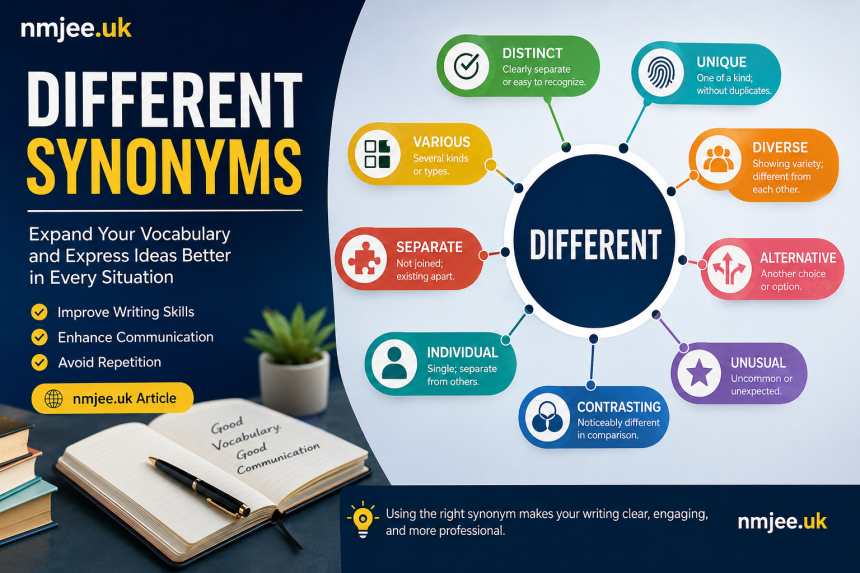
Several words can replace different depending on the situation. Although they share similar meanings, each fits specific contexts.
Distinct
The word distinct refers to something clearly separate or easy to recognize. It emphasizes uniqueness and clarity.
Example:
The company developed a distinct marketing strategy that separated it from competitors.
Unique
Unique describes something that is one of a kind. Therefore, it should only describe things without exact duplicates.
Example:
Every fingerprint is unique.
Various
Various refers to multiple kinds or several types. Consequently, it works well when discussing a range of options.
Example:
The store offers various clothing styles.
Diverse
Diverse highlights variety among people, ideas, cultures, or objects. Moreover, it often suggests richness through differences.
Example:
The city has a diverse population.
Alternative
Alternative means another choice or option. Therefore, it fits situations involving decisions.
Example:
They found an alternative solution to the problem.
Unusual
Unusual describes something uncommon or unexpected. As a result, it often attracts attention.
Example:
She wore an unusual outfit to the event.
Contrasting
Contrasting emphasizes noticeable differences between two or more things.
Example:
The two paintings display contrasting artistic styles.
Separate
Separate indicates that things are not joined together. Consequently, it works well when describing physical or conceptual divisions.
Example:
The files remain in separate folders.
Individual
Individual focuses on a single person or object rather than a group.
Example:
Each individual student received personal feedback.
Distinctive
Distinctive refers to features that make something easy to identify.
Example:
The restaurant has a distinctive interior design.
Different Synonyms by Context

Selecting the correct synonym depends on the situation. Therefore, understanding context is essential.
For people, words like unique, individual, and distinctive work well. Meanwhile, diverse is ideal when discussing communities or cultures.
For objects, distinct, separate, and contrasting often provide the best alternatives.
For choices, alternative remains the most appropriate option.
For collections, various effectively describes multiple types or categories.
Formal Alternatives to Different
Professional writing often requires more precise language. Consequently, these words are commonly used in business, academic, and technical documents.
Words such as distinct, diverse, alternative, separate, and individual create a polished tone. Moreover, they improve clarity without sounding repetitive.
For example, instead of writing, “The company offers different services,” you can write, “The company offers diverse services.”
Similarly, replace “different departments” with “separate departments” when discussing organizational structures.
Creative Alternatives for Everyday Writing
Creative writing benefits from descriptive vocabulary. Therefore, replacing different with expressive alternatives strengthens your message.
Instead of saying someone has a different personality, describe them as unique, distinctive, or unconventional.
Likewise, rather than mentioning different colors, use varied, contrasting, or assorted colors. As a result, your descriptions become more vivid.
Words Similar to Different
Several related words share similar meanings while offering slightly different shades of expression.
These include:
- Distinct
- Unique
- Diverse
- Various
- Separate
- Alternative
- Contrasting
- Individual
- Distinctive
- Unusual
- Varied
- Assorted
- Unlike
- Uncommon
- Exceptional
Although these words relate closely, always choose the one that matches your intended meaning.
Common Mistakes When Replacing Different
Many writers use synonyms incorrectly. However, careful word selection prevents confusion.
For instance, unique should describe something truly one of a kind. Meanwhile, various simply indicates several types.
Likewise, alternative suggests another option rather than a noticeable difference. Similarly, diverse highlights variety within a group rather than comparing two individual items.
Therefore, always consider context before selecting a replacement.
Tips for Using Different Synonyms Effectively
Read each sentence carefully before replacing different. Next, determine whether you are describing uniqueness, variety, separation, or contrast. After that, select the synonym that communicates your idea naturally.
Additionally, avoid forcing complicated words into simple sentences. Instead, prioritize clarity while maintaining variety. Consequently, your writing will sound both professional and engaging.
Conclusion
Finding the right different synonym improves writing quality and strengthens communication. Moreover, it helps eliminate repetitive language while making your content more engaging. Whether you choose distinct, unique, diverse, various, or alternative, every synonym serves a specific purpose. Therefore, understanding these differences allows you to write with greater confidence, precision, and style in every situation.