






If you’re exploring the International Baccalaureate (IB) programme, you’ve probably come across the term “IB Learner Profile” more than once. It sits at the heart of everything the IB stands for, shaping how students learn, think, and interact with the world around them. In this guide, we’ll break down what the IB Learner Profile is, explore each of its ten attributes in detail, and explain why it matters so much for a student’s academic and personal growth.
What Is the IB Learner Profile?

The IB Learner Profile is a set of ten attributes that describe the kind of learner the International Baccalaureate Organization (IBO) hopes to develop through its four programmes: the Primary Years Programme (PYP), Middle Years Programme (MYP), Diploma Programme (DP), and Career-related Programme (CP).
Rather than focusing purely on academic achievement, the Learner Profile aims to shape well-rounded individuals who are prepared to thrive in an increasingly interconnected and rapidly changing world. It’s less about what students know and more about who they become as a result of their education.
The IBO describes these attributes as a shared mission across all IB World Schools, regardless of country, curriculum stage, or subject area. Whether a student is studying mathematics, art, or language acquisition, the Learner Profile is meant to be woven into every part of their educational journey.
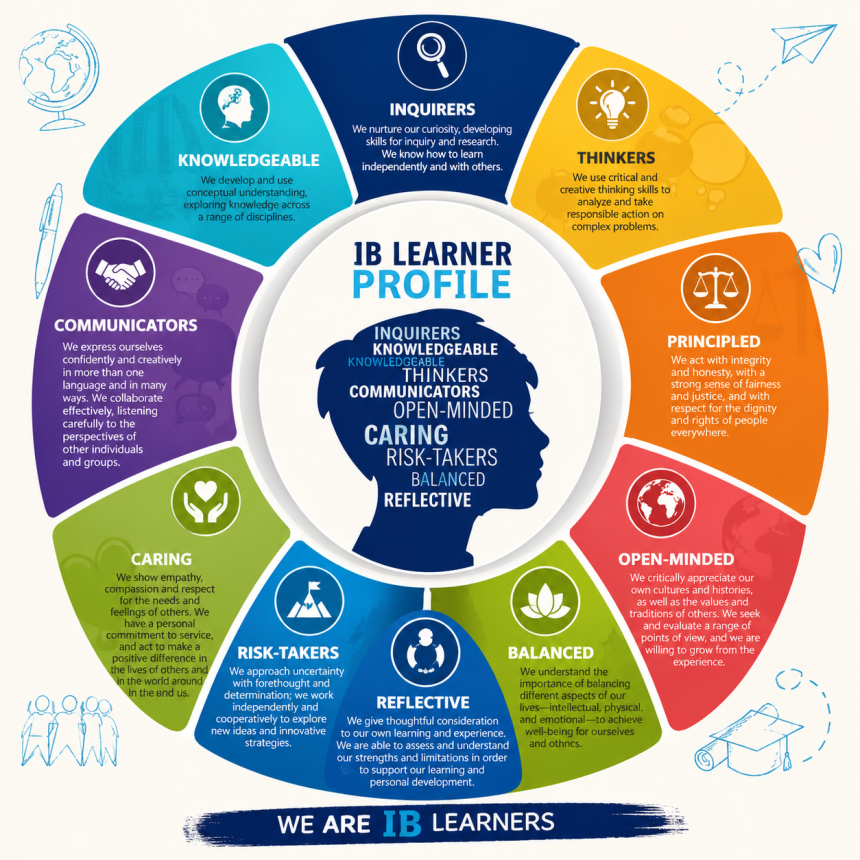
The Ten Attributes of the IB Learner Profile

Let’s take a closer look at each of the ten traits that make up the Learner Profile.
1. Inquirers
IB learners are encouraged to nurture their natural curiosity. They develop skills for inquiry and research, learn independently, and carry an enthusiasm for learning that stays with them throughout life. Inquiry-based learning is a cornerstone of the IB philosophy, pushing students to ask questions rather than simply memorize answers.
2. Knowledgeable
IB students explore concepts, ideas, and issues that have local and global significance. In doing so, they acquire in-depth knowledge and develop understanding across a broad and balanced range of disciplines. The goal isn’t just to accumulate facts, but to make meaningful connections between subjects.
3. Thinkers
Critical and creative thinking skills are essential to the IB approach. Learners are taught to analyze complex problems and take responsible action through reasoned, ethical decision-making. This attribute encourages students to look beyond surface-level information and evaluate ideas from multiple perspectives.
4. Communicators
Effective communication is central to the IB Learner Profile. Students learn to express themselves confidently and creatively in more than one language and in a variety of modes of communication. They also learn to listen carefully and collaborate effectively with others, recognizing that communication is a two-way process.
5. Principled
IB learners act with integrity and honesty, along with a strong sense of fairness, justice, and respect for the dignity of individuals, groups, and communities. They take responsibility for their own actions and the consequences that accompany them. This attribute lays the groundwork for ethical leadership later in life.
6. Open-Minded
Understanding and appreciating one’s own culture and personal history, while remaining open to the perspectives, values, and traditions of other individuals and communities, is a key part of being an IB learner. Open-mindedness encourages students to seek and evaluate a range of viewpoints, and to grow from the experience.
7. Caring
Empathy, compassion, and respect are woven into the IB Learner Profile through the attribute of being caring. Students are encouraged to have a personal commitment to service and to act in ways that make a positive difference in the lives of others and in the environment around them.
8. Risk-Takers (Courageous)
IB learners approach uncertainty with forethought and determination. They work independently and cooperatively to explore new ideas and innovative strategies, and they’re resourceful and resilient in the face of challenges or change. This attribute helps students build the confidence to step outside their comfort zones.
9. Balanced
Balance is about understanding the importance of intellectual, physical, and emotional well-being for themselves and others. IB learners recognize their interdependence with other people and with the world in which they live, striving for equilibrium across different aspects of life rather than overemphasizing one area at the expense of another.
10. Reflective
Finally, IB learners give thoughtful consideration to their own learning and experience. They’re able to assess and understand their strengths and weaknesses in order to support their learning and personal development. Reflection is treated not as an afterthought, but as an ongoing part of the learning cycle.
Why the IB Learner Profile Matters

It Builds Well-Rounded Individuals
Unlike traditional education models that often prioritize test scores and grades above all else, the IB Learner Profile takes a holistic view of student development. It recognizes that academic success alone doesn’t prepare students for the complexities of adult life, professional careers, or global citizenship. By focusing on character traits alongside academic skills, the IB aims to produce graduates who are not only knowledgeable but also compassionate, ethical, and adaptable.
It Prepares Students for a Globalized World
In today’s interconnected world, cultural competence and international-mindedness are more valuable than ever. The Learner Profile attributes of being open-minded, caring, and principled help students develop the cross-cultural understanding needed to work and live alongside people from vastly different backgrounds. This is particularly relevant for students who may study, work, or travel internationally in the future.
It Encourages Lifelong Learning
The attributes of being an inquirer, thinker, and reflective learner all point toward one overarching goal: fostering a love of learning that extends far beyond the classroom. Rather than treating education as something that ends with graduation, the IB Learner Profile instills habits of curiosity and self-improvement that can last a lifetime.
It Supports Emotional and Social Development
Traits like being balanced and caring acknowledge that academic achievement isn’t the only measure of a successful education. Emotional intelligence, self-awareness, and social responsibility are just as important, and the IB Learner Profile ensures these areas receive dedicated attention throughout a student’s schooling.
How Schools Implement the IB Learner Profile
IB World Schools integrate the Learner Profile into daily classroom practices, not just as a poster on the wall but as a living framework. Some common strategies include:
- Embedding attributes into lesson planning: Teachers design units of inquiry that deliberately target specific Learner Profile traits, connecting academic content with character development.
- Reflection journals and portfolios: Students regularly document their growth against the ten attributes, building self-awareness over time.
- Service and action projects: Programmes like CAS (Creativity, Activity, Service) in the Diploma Programme give students concrete opportunities to practice being caring, principled, and risk-taking.
- Assessment feedback: Teachers often reference Learner Profile attributes when giving feedback, helping students see the connection between their conduct and their coursework.
Tips for Parents Supporting an IB Learner
If your child is enrolled in an IB programme, here are a few ways you can reinforce the Learner Profile at home:
- Model the attributes yourself. Children often learn by observing adults, so demonstrating open-mindedness, reflection, and balance in your own life reinforces the lessons taught at school.
- Discuss the attributes in everyday contexts. When watching the news or discussing family decisions, ask your child which Learner Profile traits might apply.
- Encourage reflection. After a challenging assignment or event, ask open-ended questions like “What did you learn about yourself?” rather than only focusing on outcomes.
- Celebrate effort, not just results. Praising resilience and risk-taking, even when a project doesn’t turn out perfectly, reinforces the value the IB places on the learning process itself.
Final Thoughts
The IB Learner Profile isn’t just an educational buzzword. It’s a carefully designed framework meant to shape thoughtful, capable, and compassionate individuals who are ready to engage with an ever-changing world. By understanding and embracing these ten attributes, students, parents, and educators alike can work together to create a richer, more meaningful learning experience.
Whether you’re new to the IB system or looking to deepen your understanding, keeping the Learner Profile at the center of the educational journey ensures that students grow not just as scholars, but as well-rounded human beings ready to make a positive impact on the world.