






Flag football has rapidly evolved into one of the most exciting and strategic variations of the game. Unlike traditional tackle football, it emphasizes speed, agility, and smart decision-making over physical contact. Because of this, success in flag football depends heavily on well-designed plays and how effectively teams execute them. Powerful flag football plays are not just about scoring touchdowns; they are about controlling the tempo of the game, creating opportunities, and maximizing each player’s strengths.
Understanding how to use these plays effectively can transform an average team into a competitive force. Whether you are coaching a youth team or playing at a competitive level, mastering the right plays can significantly improve both performance and scoring chances.
The Importance of Strategy in Flag Football
In flag football, strategy is everything. Since players cannot rely on physical tackles to stop opponents, positioning and anticipation become essential. Offensive plays must be designed to create separation, confuse defenders, and open passing lanes. At the same time, defensive plays must anticipate movement and limit space.
A well-structured playbook provides teams with a clear plan of action. It allows players to understand their roles and execute plays with confidence. Teams that rely on random or unorganized plays often struggle against opponents who have practiced structured formations and timing-based strategies.
Moreover, strategy builds consistency. When players repeatedly practice powerful plays, they develop chemistry, which leads to smoother execution during games. This consistency is often the difference between winning and losing close matches.
Offensive Plays That Create Scoring Opportunities
Offense is where powerful flag football plays truly shine. The goal is not just to move the ball forward but to do so efficiently while creating high-percentage scoring chances.
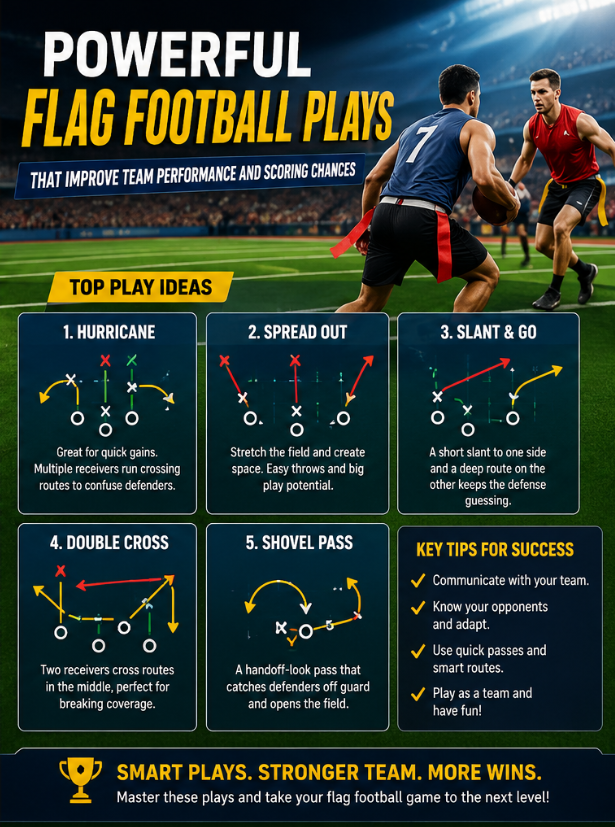
One of the most effective offensive strategies is spreading the field. By positioning receivers across different areas, the defense is forced to cover more ground. This creates gaps that can be exploited through quick passes or well-timed runs. Plays that involve crossing routes are particularly effective because they naturally create confusion among defenders, often leading to open receivers.
Another powerful offensive concept is the use of misdirection. In these plays, the offense initially shows one type of movement, such as a run to one side, but quickly shifts direction. This forces defenders to commit early, creating opportunities on the opposite side of the field. When executed properly, misdirection plays can lead to big gains and even touchdowns.
Timing also plays a critical role in offensive success. Quarterbacks must release the ball at the right moment, while receivers must run precise routes. Even the best-designed plays can fail if timing is off. Therefore, practicing synchronization between players is essential for maximizing scoring chances.
The Role of the Quarterback in Executing Plays
The quarterback is the leader of the offense and plays a central role in executing powerful flag football plays. A skilled quarterback does more than just throw the ball; they read the defense, make quick decisions, and adjust plays when necessary.

In flag football, where time is limited and defenses react quickly, the quarterback must be decisive. Holding onto the ball for too long often leads to missed opportunities. Successful quarterbacks learn to identify open receivers early and deliver accurate passes under pressure.
Communication is another key responsibility. Before the snap, the quarterback must ensure that all players understand the play. Clear communication reduces mistakes and increases the chances of successful execution.
Additionally, mobility can be a significant advantage. A quarterback who can move quickly can extend plays, avoid defenders, and create opportunities when the original plan breaks down. This flexibility adds another layer of unpredictability to the offense.
Defensive Plays That Stop the Opposition
While offense wins games, defense ensures that opponents do not outscore you. Powerful defensive plays are designed to limit space, force mistakes, and create turnovers.
One effective defensive strategy is zone coverage. In this approach, players are assigned specific areas of the field rather than individual opponents. This allows defenders to react to the ball more effectively and prevents easy passes. Zone coverage works particularly well against teams that rely on short, quick passes.
Man-to-man coverage, on the other hand, is useful when facing teams with strong individual players. By closely marking key receivers, defenders can disrupt routes and reduce scoring opportunities. However, this approach requires discipline and awareness, as a single mistake can lead to a big play.
Blitzing is another powerful defensive tactic. By sending an extra rusher toward the quarterback, the defense can force quick decisions and increase the chances of errors. However, blitzing must be used carefully, as it can leave parts of the field exposed if not executed properly.
Ultimately, successful defensive plays rely on teamwork and communication. Players must trust each other and work together to cover the field effectively.
The Power of Practice and Repetition

Even the most powerful flag football plays are ineffective without proper practice. Repetition helps players understand their roles and improves their ability to execute plays under pressure.
During practice, teams should focus on both individual skills and team coordination. Drills that emphasize route running, passing accuracy, and defensive positioning can significantly improve performance. At the same time, practicing full plays allows players to develop timing and chemistry.
Coaches should also encourage players to learn from mistakes. Reviewing game footage or discussing errors can help identify areas for improvement. Over time, this continuous learning process leads to better decision-making and more effective execution.
Consistency in practice builds confidence. When players know they have mastered a play, they are more likely to execute it successfully during a game. This confidence often translates into better performance and higher scoring chances.
Adapting Plays to Different Situations
No single play works in every situation. Successful teams understand the importance of adapting their strategies based on the game context.
For example, short-yardage situations may require quick, direct plays that focus on gaining small but crucial distances. On the other hand, long-yardage situations may call for more complex plays designed to create bigger gains.
Weather conditions, field size, and the skill level of opponents can also influence play selection. Teams that can adjust their strategies quickly have a significant advantage over those that rely on a fixed playbook.
Flexibility is key. Coaches and players must be willing to modify plays or try new approaches when necessary. This adaptability ensures that the team remains competitive regardless of the circumstances.
Building Team Chemistry Through Plays
Powerful flag football plays are not just about strategy; they also play a role in building team chemistry. When players understand each other’s movements and tendencies, they can execute plays more effectively.
Trust is an essential component of this chemistry. Players must trust that their teammates will perform their roles correctly. This trust allows for smoother execution and reduces hesitation during critical moments.
Communication also strengthens team dynamics. Regular discussions during practice and games help players stay aligned and address any issues quickly. Over time, this open communication creates a more cohesive and confident team.
Teams with strong chemistry often outperform more talented opponents because they work together more effectively. This highlights the importance of teamwork in achieving success in flag football.
Increasing Scoring Chances with Smart Play Design
Designing plays with scoring in mind requires creativity and understanding of the game. Effective plays often combine multiple elements, such as motion, spacing, and timing, to create opportunities.
One key principle is to keep the defense guessing. Predictable plays are easier to defend, so mixing different strategies is essential. Alternating between short passes, deep routes, and running plays can keep the defense off balance.
Another important factor is exploiting weaknesses. Observing the opponent’s defense can reveal patterns or vulnerabilities that can be targeted. For example, if a defender struggles to keep up with fast receivers, plays that involve deep routes can be highly effective.
Efficiency is also crucial. Instead of relying on risky plays, teams should focus on high-percentage options that consistently gain yards. Over time, these small gains can lead to scoring opportunities.
The Mental Aspect of the Game
Flag football is as much a mental game as it is a physical one. Players must stay focused, make quick decisions, and remain calm under pressure.
Confidence plays a significant role in performance. Players who believe in their abilities are more likely to take calculated risks and execute plays effectively. Building this confidence requires both practice and positive reinforcement.
Discipline is equally important. Sticking to the game plan and avoiding unnecessary mistakes can make a significant difference in the outcome of a match. Teams that maintain discipline are better equipped to handle challenging situations.
Mental preparation, such as visualizing plays and understanding opponent strategies, can also enhance performance. By preparing mentally, players can react more quickly and make better decisions during the game.
Conclusion
Powerful flag football plays are the foundation of team success. They provide structure, create opportunities, and enhance overall performance. From offensive strategies that maximize scoring chances to defensive tactics that limit opponents, every aspect of the game benefits from well-designed plays.
However, success does not come from plays alone. It requires practice, teamwork, adaptability, and mental strength. Teams that combine these elements are more likely to achieve consistent success and improve their scoring chances.
As flag football continues to grow in popularity, the importance of strategy and innovation will only increase. By mastering powerful plays and continuously improving, teams can stay competitive and enjoy the excitement of the game at every level.