






When we think about the greatest builders in human history, the Romans almost always come to mind first. Roman architecture is not just about old buildings and broken columns. It is about a civilization that changed the way humans design, build, and live in cities. Even today, more than two thousand years later, we still use ideas that the Romans invented. From the roads we drive on to the domes on top of famous buildings, Roman architecture is all around us, even if we do not always notice it.
In this post, we will explore what made Roman architecture so special, the materials and techniques the Romans used, some of their most famous buildings, and why their architectural style still influences the world today. By the end, you will understand why architects, engineers, and travelers continue to study and admire these ancient structures, and why they remain a popular topic for anyone interested in history or design.
Why Roman Architecture Matters

Rome was not just a city. It was the center of a massive empire that stretched across Europe, North Africa, and parts of Asia. To manage such a huge empire, the Romans needed strong buildings, good roads, working water systems, and public spaces where people could gather. Architecture was not just about beauty for the Romans. It was about function, power, and control.
Roman architecture also tells a story about how a society can grow and develop over time. Early Roman buildings were simple and borrowed heavily from Greek architecture. But over the centuries, the Romans developed their own unique style, mixing practical engineering with artistic design. This combination of function and beauty is one of the biggest reasons Roman architecture is still admired today.
The Roman Building Materials
One of the biggest reasons Rome was able to build so many huge structures was because of a special material: concrete. Roman concrete, sometimes called opus caementicium, was made using volcanic ash, lime, and small rocks. This mixture was strong, durable, and could be shaped into almost any form.
What is even more amazing is that some Roman concrete structures are still standing today, thousands of years later, while modern concrete buildings sometimes start crumbling after only a few decades. Scientists have studied Roman concrete for years to understand why it lasts so long. It turns out the volcanic ash used by the Romans created chemical reactions that made the concrete stronger over time instead of weaker.
Besides concrete, Romans also used brick, stone, and marble. Marble was often used for decoration, especially in temples and public buildings, because it gave a shiny and elegant look that showed off the wealth and power of the empire.
The Romans also became experts at mass-producing bricks, which allowed them to build faster and more efficiently across their huge empire. Bricks were often used as a base layer, with stone or marble added on top for decoration. This layered approach to construction meant that buildings could be strong on the inside while still looking impressive on the outside. It also meant that ordinary Roman citizens could enjoy well-built homes and public spaces, not just the wealthy elite.
The Roman Arch: A Game-Changing Invention

If there is one architectural feature that defines Roman building style, it is the arch. Before the Romans, most buildings used simple post-and-lintel systems, which means two vertical supports holding up a flat horizontal beam. This method worked, but it limited how big or tall a structure could be.
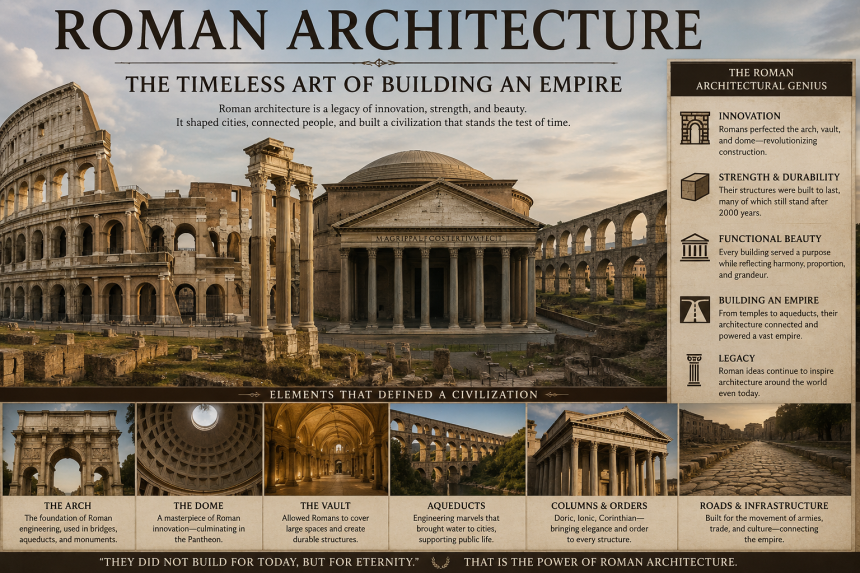
The Romans perfected the arch, allowing them to build much larger and stronger structures. Arches spread weight evenly, which means buildings could support more weight without collapsing. This simple but powerful idea allowed the Romans to build things that were never possible before, like massive aqueducts, huge public buildings, and multi-story structures.
From the arch, the Romans also developed the vault and the dome. A vault is basically a continuous arch that forms a ceiling, and a dome is a rounded structure that covers a large space without the need for internal support columns. These innovations gave Roman buildings their unique curved and open feel, something that was very different from the boxy buildings of earlier civilizations.
Famous Examples of Roman Architecture
The Colosseum
Perhaps the most famous Roman building in the world, the Colosseum in Rome was an enormous amphitheater used for gladiator battles, public shows, and other events. It could hold around 50,000 to 80,000 spectators, which is similar to the size of a modern sports stadium.
The Colosseum used a complex system of arches and vaults to support its massive structure. Its outer walls were made using different types of columns on each level, showing off the Romans’ deep understanding of Greek architectural styles while adding their own engineering improvements.
The Pantheon
The Pantheon is another masterpiece of Roman architecture. It is famous for having the largest unsupported concrete dome in the world, even after thousands of years. The dome has a hole in the center called an oculus, which lets natural light into the building. This design was both beautiful and practical, showing how the Romans combined function with art in almost everything they built.
Roman Aqueducts
While temples and arenas often get the most attention, Roman aqueducts were just as impressive, if not more. These structures carried fresh water from distant sources into cities, allowing Roman citizens to have public baths, fountains, and even indoor plumbing in some wealthy homes. Aqueducts used a slight slope and gravity to move water over long distances, sometimes across valleys using tall stone arches.
This system was so advanced that it inspired water systems used centuries later, and some Roman aqueducts are still partially functional today. Engineers today still marvel at how the Romans calculated such precise slopes without the modern tools we rely on now, using only simple instruments and careful observation.
Roman Roads
The famous saying “All roads lead to Rome” exists for a good reason. Roman roads connected the entire empire, making trade, travel, and military movement much easier. These roads were built with multiple layers, including gravel, sand, and stone, making them strong enough to survive heavy use for centuries. Some original Roman roads still exist today, which shows just how advanced their construction methods were.
Roman Influence on Modern Architecture
Roman architecture did not disappear when the empire fell. In fact, its influence can be seen all over the world today. Many government buildings, banks, and universities use Roman-style columns, domes, and arches because these elements represent strength, stability, and importance.
For example, the United States Capitol Building in Washington, D.C. uses a large dome inspired directly by Roman design. Many courthouses and museums around the world also use Roman-style columns to create a sense of authority and tradition.
Even in engineering, modern builders still study Roman concrete and construction methods to improve the durability of today’s buildings. Some companies are even experimenting with Roman-inspired concrete formulas to create longer-lasting and more environmentally friendly building materials.
Roman-style architecture also shows up in everyday places you might not expect, such as public libraries, churches, and even shopping malls. Designers often use columns, arches, and domes because these features instantly make a space feel grand, trustworthy, and timeless. This shows just how powerful and lasting the impact of Roman design has been on our modern visual culture.
What We Can Learn From Roman Architecture

Roman architecture teaches us several important lessons that still apply today.
First, function and beauty can go together. The Romans did not just build things to look nice. Every design choice had a purpose, whether it was to support weight, allow light in, or improve airflow.
Second, good materials matter. The Romans took the time to understand and improve their building materials, which is why so many of their structures have survived for thousands of years.
Third, architecture reflects values. Roman buildings were designed to show power, order, and unity. This is a reminder that architecture is never just about walls and roofs. It reflects the culture and priorities of the people who build it.
Final Thoughts
Roman architecture is more than just ancient history. It represents human creativity, engineering skill, and the desire to build something that lasts. From towering domes to long-lasting roads, the Romans left behind a legacy that continues to shape our world today.
Whether you are an architecture enthusiast, a history lover, or simply someone who enjoys learning new things, Roman architecture offers timeless lessons in design, durability, and vision. The next time you see a government building with tall columns or a bridge supported by arches, remember that you are looking at ideas that started thousands of years ago in ancient Rome.
Roman architecture reminds us that great design never truly goes out of style. It evolves, inspires, and continues to shape the buildings we live and work in today.