







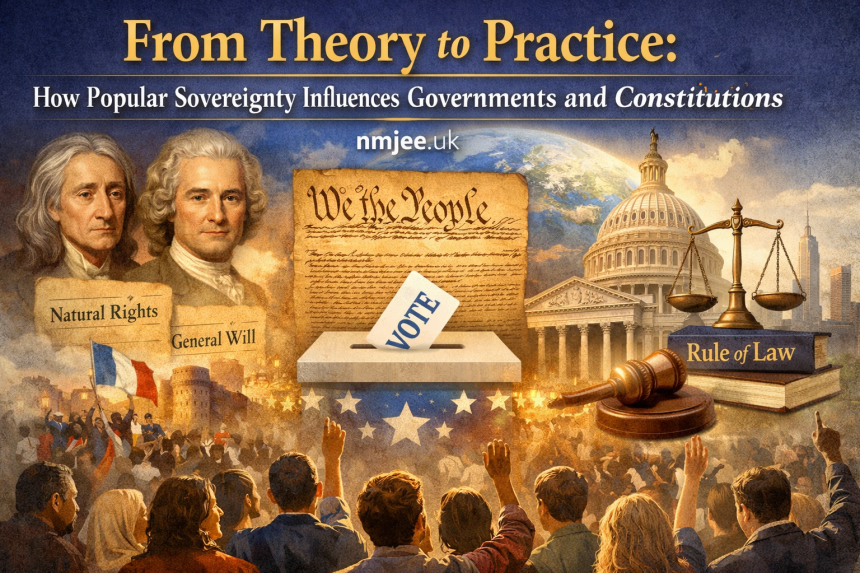
Popular sovereignty is one of the most powerful ideas in political thought, shaping how societies understand authority, legitimacy, and the role of citizens in governance. At its core, popular sovereignty holds that all political power originates from the people. Governments exist not by divine right or inherited authority, but because citizens consent to be governed. While this idea began as a philosophical concept, it has gradually moved from theory into practice, profoundly influencing modern governments and constitutional systems across the world.
The Philosophical Roots of Popular Sovereignty
The idea of popular sovereignty developed as a response to absolute monarchy and authoritarian rule. Early political philosophers questioned whether kings and rulers truly possessed unquestionable authority. Thinkers such as John Locke argued that individuals are born with natural rights and that governments are created to protect those rights. According to this view, if a government fails its citizens, the people have the right to change or replace it.
Another influential thinker, Jean-Jacques Rousseau, expanded this idea by emphasizing the “general will” of the people. Rousseau believed that true political authority comes from collective agreement and shared interests, not from rulers acting independently of the population. These philosophical foundations laid the groundwork for popular sovereignty as a guiding principle of democratic governance.
From Abstract Idea to Political Revolution
For centuries, popular sovereignty remained largely theoretical, discussed in books and academic circles. Its transformation into practice came through political upheaval and revolution. As citizens grew dissatisfied with unresponsive and unequal systems of rule, the idea that power belonged to the people gained momentum.
The concept played a central role in revolutionary movements that challenged traditional authority. Rather than accepting inherited power, revolutionaries argued that legitimacy must be earned through public consent. This shift marked a turning point in political history, redefining the relationship between citizens and the state.
Popular Sovereignty and Constitutional Design

One of the most important ways popular sovereignty influences governments is through constitutions. A constitution serves as a foundational document that outlines how power is structured, exercised, and limited. In systems based on popular sovereignty, the constitution is not granted by a ruler but created in the name of the people.
A clear example of this principle in action is the United States Constitution, which famously begins with the words “We the People.” This phrase symbolizes the idea that governmental authority flows upward from citizens rather than downward from elites. By embedding popular sovereignty into constitutional language, governments signal that they derive legitimacy from public approval.
Constitutions shaped by popular sovereignty typically include mechanisms for citizen participation, such as elections, representation, and amendments. These features allow the people to influence government over time, ensuring that authority remains connected to public will rather than becoming concentrated in the hands of a few.
The Role of Elections and Representation
Elections are one of the most visible expressions of popular sovereignty in practice. Through voting, citizens delegate authority to representatives who act on their behalf. While elected officials exercise power, that power remains conditional. Leaders can be replaced if they fail to reflect the preferences or interests of the population.
This system reinforces accountability. Governments influenced by popular sovereignty must regularly seek public approval, creating incentives to respond to citizen concerns. Even in representative systems where citizens do not vote directly on every issue, the underlying principle remains the same: authority is temporary and dependent on consent.
Popular Sovereignty and the Rule of Law
Another important impact of popular sovereignty is its relationship with the rule of law. When power originates from the people, laws are seen as expressions of collective agreement rather than commands imposed from above. This perspective strengthens respect for legal systems, as citizens view laws as products of shared values and democratic processes.

At the same time, popular sovereignty places limits on government authority. Constitutions often include protections for individual rights, ensuring that majority rule does not override fundamental freedoms. In this way, popular sovereignty balances collective power with individual dignity, shaping governments that are both democratic and restrained.
Challenges in Applying Popular Sovereignty
While popular sovereignty is a powerful ideal, applying it in practice is not without challenges. Modern states are large and complex, making direct participation by all citizens difficult. As a result, representation becomes necessary, but it can also create distance between the people and decision-makers.
There is also the risk that popular sovereignty may be weakened by low political participation, misinformation, or unequal access to power. When citizens disengage or lack trust in institutions, the link between government and public consent can erode. This highlights an important truth: popular sovereignty is not self-sustaining. It requires active civic engagement, transparent institutions, and ongoing public education.
Popular Sovereignty in a Global Context
The influence of popular sovereignty is not limited to one country or region. Its principles have shaped constitutional systems across continents, inspiring movements for independence, self-determination, and democratic reform. Historical events such as the French Revolution demonstrated how demands for popular control could dismantle long-standing hierarchies and redefine political authority.
Today, popular sovereignty continues to influence debates about constitutional reform, national identity, and democratic legitimacy. In a globalized world, questions about who truly holds power remain central to political discourse, making the concept as relevant as ever.
Bridging Theory and Practice
The journey of popular sovereignty from philosophical theory to practical governance shows how ideas can reshape reality. What began as a challenge to absolute power has become a defining feature of modern political systems. By influencing constitutions, elections, and legal frameworks, popular sovereignty transforms abstract ideals into everyday political practices.
However, its success depends on more than written documents or formal institutions. Popular sovereignty lives through participation, accountability, and shared responsibility. When citizens remain engaged and informed, governments are more likely to reflect the will of the people.
Conclusion
Popular sovereignty stands as a cornerstone of modern democratic thought, linking political authority to public consent. Its influence on governments and constitutions has reshaped how power is understood and exercised, replacing inherited rule with citizen-driven legitimacy. While challenges remain, the principle continues to guide efforts to create more inclusive, accountable, and responsive systems of governance.
From theory to practice, popular sovereignty reminds societies that government is not an external force, but a collective creation. As long as people continue to assert their role in shaping political life, popular sovereignty will remain a vital force in the evolution of democracy.