







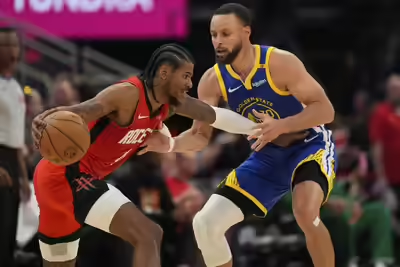
The clash between the Houston Rockets and the Golden State Warriors has long been one of the most exciting matchups in modern basketball. These two teams represent contrasting styles, eras, and philosophies, yet every time they meet on the court, the game delivers intensity, skill, and drama. In this blog-style analysis, we will explore a recent matchup between these teams, focusing on player statistics, individual performances, and how those numbers translate into the overall outcome of the game.
Setting the Stage: A Battle of Styles
The Houston Rockets have been in a rebuilding phase in recent seasons, focusing on developing young talent and building a future core. Meanwhile, the Golden State Warriors continue to rely on their championship experience, led by veteran stars who have defined the modern NBA era. This difference creates an intriguing dynamic: youthful energy versus seasoned excellence.
From the opening tip-off, the tempo of the game reflects these identities. The Rockets push the pace, looking for fast-break opportunities, while the Warriors rely on ball movement, spacing, and perimeter shooting. These stylistic differences are reflected clearly in the player statistics that emerge by the end of the game.
First Half Breakdown: Offensive Firepower on Display
In the first half, both teams showcased their offensive strengths. For the Warriors, Stephen Curry once again proved why he is considered one of the greatest shooters in NBA history. He scored 18 points in the first two quarters alone, shooting efficiently from beyond the arc and creating space with his off-ball movement. His ability to draw defenders opened opportunities for teammates like Klay Thompson, who contributed 12 points with his signature catch-and-shoot style.
On the Rockets’ side, young star Jalen Green led the charge. Green displayed his scoring versatility, attacking the rim and knocking down mid-range jumpers. He ended the first half with 16 points, showing confidence and aggression. Supporting him was Alperen Şengün, whose playmaking from the center position added a unique dimension to Houston’s offense. Şengün recorded 6 assists in the first half, orchestrating plays and creating scoring opportunities for teammates.
Statistically, the first half was evenly matched. The Warriors shot a higher percentage from three-point range, while the Rockets dominated points in the paint. Rebounds were nearly equal, but Houston had a slight edge in offensive boards, giving them second-chance opportunities.
Defensive Adjustments and Momentum Shifts

As the second half began, both teams made key defensive adjustments. The Warriors focused on limiting Green’s penetration by collapsing the defense and forcing outside shots. Meanwhile, the Rockets attempted to contain Curry by switching defenders and applying more pressure beyond the three-point line.
Draymond Green played a crucial role for Golden State during this stretch. While his scoring numbers were modest, his defensive presence and playmaking were invaluable. He recorded multiple steals and assists, disrupting Houston’s rhythm and initiating fast breaks. His stat line—8 points, 9 rebounds, 7 assists, and 3 steals—demonstrates his all-around impact beyond scoring.
For the Rockets, Fred VanVleet stepped up as a leader. His experience was evident as he controlled the tempo and made smart decisions under pressure. VanVleet contributed 14 points and 8 assists, helping Houston stay competitive despite the Warriors’ defensive intensity.
Key Player Performances: Breaking Down the Numbers
When analyzing player stats, it becomes clear that individual performances often dictate the outcome of such closely contested games. Stephen Curry finished the game with 32 points, 6 assists, and 5 rebounds. His shooting efficiency, particularly from three-point range, was a major factor in the Warriors’ offensive success. Every time Houston threatened to take the lead, Curry responded with a timely basket.
Klay Thompson added 24 points, providing consistent scoring support. His ability to stretch the floor forced the Rockets’ defense to spread out, creating driving lanes for teammates. Together, Curry and Thompson combined for over half of the Warriors’ total points, highlighting their importance.
On the Rockets’ side, Jalen Green ended with 28 points, showcasing his growth as a primary scorer. His performance was complemented by Alperen Şengün, who recorded a near triple-double with 18 points, 10 rebounds, and 9 assists. Şengün’s versatility makes him a cornerstone for Houston’s future.
Another notable contribution came from Jabari Smith Jr., who added 15 points and 7 rebounds. His defensive efforts against the Warriors’ forwards were also significant, as he managed to contest shots and limit second-chance opportunities.
Bench Contributions and Depth Analysis
One of the key differences in the game came from the bench. The Warriors’ depth proved to be a decisive factor. Players like Jonathan Kuminga and Moses Moody provided valuable minutes, contributing energy, defense, and scoring. Kuminga, in particular, stood out with 12 points and strong defensive plays.
In contrast, the Rockets’ bench struggled to maintain consistency. While there were moments of promise, the lack of scoring depth allowed the Warriors to maintain their lead during crucial stretches. This disparity in bench production is often reflected in the final score and highlights the importance of having a well-rounded roster.
Fourth Quarter Drama: Clutch Performances
The fourth quarter brought heightened intensity as both teams fought for control. The Rockets managed to close the gap, thanks to a scoring run led by Jalen Green and Fred VanVleet. However, the Warriors’ experience ultimately prevailed.
Stephen Curry delivered in the clutch, scoring 10 points in the final quarter, including two crucial three-pointers that shifted momentum back in Golden State’s favor. His composure under pressure is a defining characteristic of his career and was evident once again in this game.
Defensively, Draymond Green and the Warriors tightened their grip, forcing turnovers and limiting Houston’s scoring opportunities in the closing minutes. These defensive plays, though less glamorous than scoring, were instrumental in securing the win.

Statistical Summary and Insights
Looking at the overall statistics, the Warriors shot approximately 48% from the field and 40% from three-point range, compared to the Rockets’ 45% field goal percentage and 33% from beyond the arc. The difference in three-point shooting proved to be a critical factor.
Rebounding was nearly even, but the Warriors had fewer turnovers, which translated into more efficient offensive possessions. Assists were also slightly in favor of Golden State, reflecting their emphasis on ball movement and teamwork.
These numbers illustrate how efficiency, rather than sheer volume, often determines the outcome of a game. The Warriors maximized their opportunities, while the Rockets showed promise but lacked consistency in key moments.
What This Game Means for Both Teams
For the Golden State Warriors, this victory reinforces their status as a competitive team capable of contending with both young and experienced opponents. Their reliance on veteran leadership, combined with contributions from younger players, creates a balanced and effective roster.
For the Houston Rockets, the game serves as a learning experience. Despite the loss, the performances of Jalen Green and Alperen Şengün highlight the team’s potential. With continued development and improved bench production, the Rockets are poised to become a formidable force in the future.
Final Thoughts
The matchup between the Houston Rockets and the Golden State Warriors is more than just a game; it is a reflection of the evolving nature of the NBA. On one side, a young team striving to establish its identity; on the other, a seasoned group aiming to extend its legacy.
Player statistics provide a window into this narrative, revealing not only individual achievements but also the underlying dynamics of the game. From Stephen Curry’s scoring brilliance to Alperen Şengün’s all-around performance, each stat tells a story of effort, strategy, and competition.