








Understanding energy doesn’t always require a physics degree. In fact, one of the simplest and most relatable forms of energy—potential energy—is something we interact with daily without even noticing. Whether it’s a book resting on a shelf, water stored in a dam, or a child sitting at the top of a slide, potential energy plays a quiet but essential role in how the world functions.
In this guide, we’ll break down what a potential energy calculator is, why it matters, and how anyone can use it. If you’ve ever wondered how scientists, engineers, and even smartphone apps estimate stored energy, you’re in the right place.
Think of this article as a friendly walk through the world of potential energy—simple, clear, and sprinkled with everyday examples.
Introduction to Potential Energy
Imagine holding a stretched rubber band in your hand. The moment it’s stretched, it holds energy—even before you let it go. That “ready-to-release” feeling is exactly what potential energy is all about: stored energy waiting to be used.
Potential energy exists everywhere, from a raindrop hanging on a leaf to a roller coaster at the peak of its track. And this is where a potential energy calculator becomes incredibly useful—it helps you quantify that stored energy.
What Is a Potential Energy Calculator?
A potential energy calculator is a simple tool—digital or physical—that helps you calculate the amount of stored energy in an object based on its position, shape, or chemical state.
Think of it as a digital assistant that translates natural phenomena into understandable numbers.
It usually relies on formulas that consider mass, height, gravity, and other factors, depending on the type of potential energy.
Why Potential Energy Matters in Daily Life
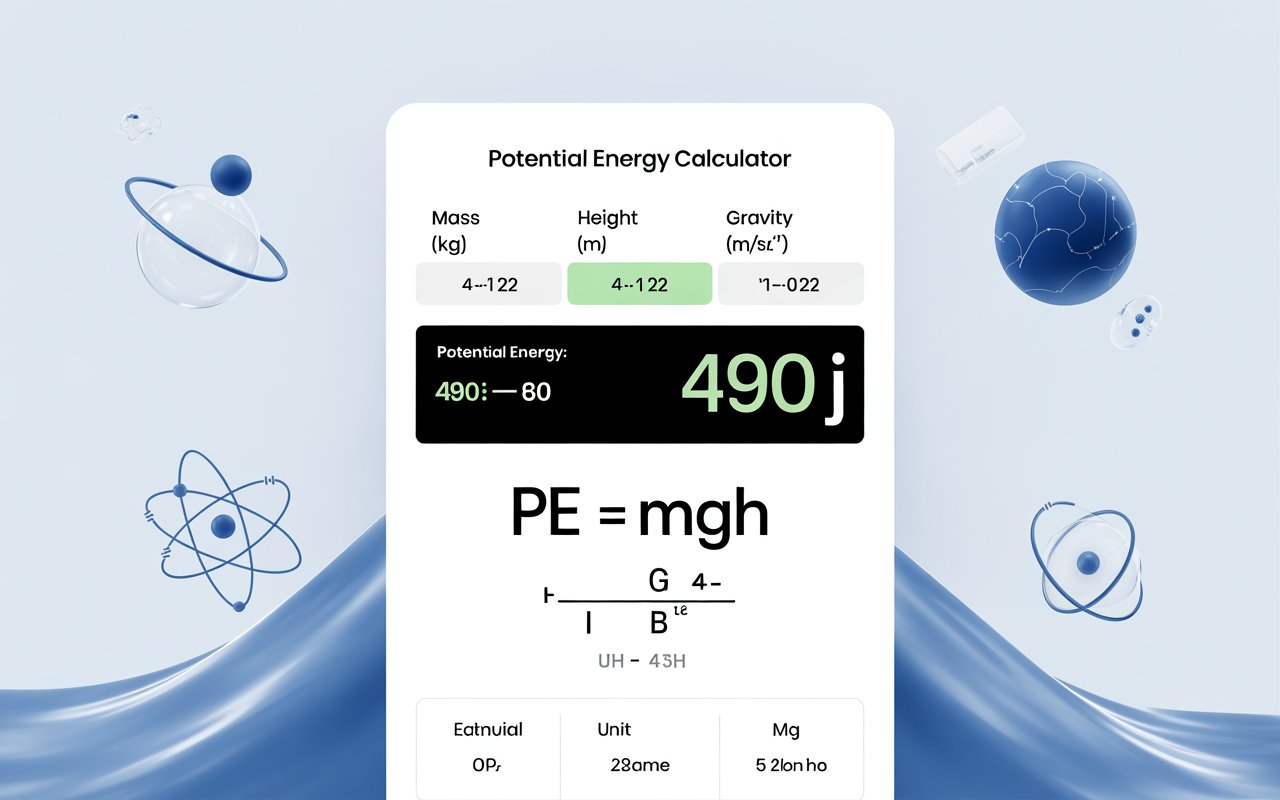
You may not realize it, but potential energy influences daily life more than you think.
Here are some everyday scenarios:
-
Water stored behind a dam uses gravitational potential energy to power turbines.
-
A raised hammer uses potential energy before striking a nail.
-
Batteries rely on chemical potential energy to run your devices.
-
Children climbing playground structures build up potential energy before sliding or jumping.
In short, potential energy is like the “battery” of nature—silent but powerful.
Types of Potential Energy
Potential energy comes in different forms depending on what stores the energy. Let’s break down the major types that most calculators deal with.
1. Gravitational Potential Energy
This is the most common type and the one calculators usually focus on.
It depends on:
-
The mass of the object
-
The height from the ground
-
The force of gravity
A rock held at a height has more gravitational potential energy than the same rock at ground level.
2. Elastic Potential Energy
This is energy stored in stretched or compressed objects, such as:
-
Springs
-
Rubber bands
-
Elastic cords
-
Trampolines
When you stretch or compress them, they hold energy until released.
3. Chemical Potential Energy
This is energy stored in:
-
Food
-
Fuel
-
Batteries
-
Cells
Although calculators commonly focus on physical potential energy, chemical energy is a major part of modern life—from powering cars to feeding our bodies.
4. Electrical Potential Energy
This relates to the position of charged particles.
Examples include:
-
Capacitors
-
Lightning clouds
-
Static electricity
-
Power sources
Electrical potential helps everything from your home appliances to your phone battery.
How a Potential Energy Calculator Works
Even though the interface of a calculator seems simple—usually fields like mass, height, and gravity—it’s doing a lot behind the scenes.
Here is what typically happens:
-
You input basic values (e.g., mass in kilograms).
-
The calculator applies the appropriate formula.
-
It processes the numerical operation instantly.
-
It gives you the stored energy in joules (J).
Some calculators allow switching between unit systems, while advanced ones handle different types of potential energy.
Key Components Used in Calculation
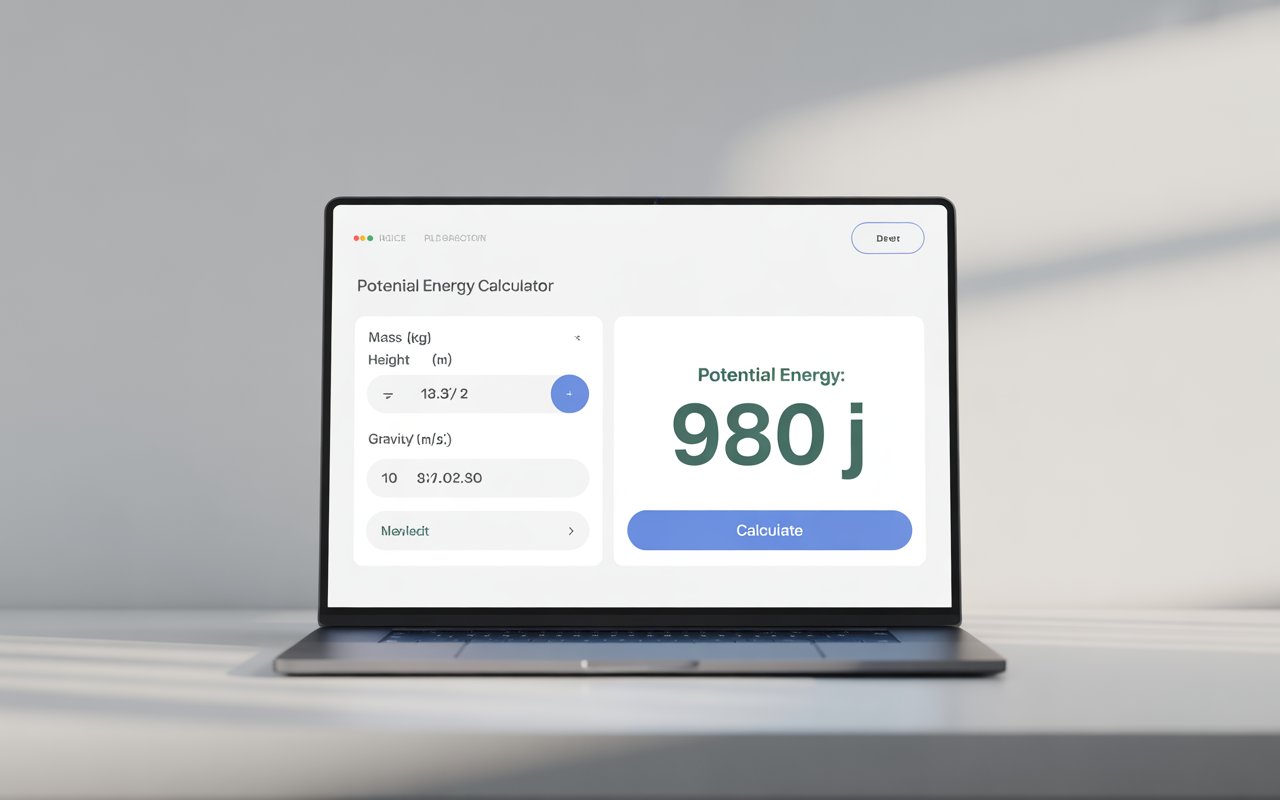
Different types of potential energy have different factors, but the most common ones include:
Mass
Heavier objects have more potential energy.
Height
Higher elevation means more stored gravitational energy.
Gravity
Earth’s gravitational acceleration is typically taken as 9.8 m/s².
Spring Constant
Used in elastic potential calculations; measures how stiff a spring is.
Compression or Extension
How much the object is stretched or compressed.
Charge
Relevant in calculating electrical potential.
Understanding these inputs helps anyone use a potential energy calculator confidently.
Formula Breakdown: Gravitational Potential Energy
The most widely used equation is:
PE = m × g × h
Where:
-
PE = Potential Energy (Joules)
-
m = Mass (kg)
-
g = Acceleration due to gravity (m/s²)
-
h = Height (meters)
Think of it like stacking building blocks: the higher you go, the more energy you’re storing.
Here’s a simple example:
If you lift a 2 kg object to a height of 3 meters, the energy stored is:
PE = 2 × 9.8 × 3 = 58.8 J
Just like that, a calculator shows the stored energy without the manual math.
Real-Life Examples You Can Relate To
A potential energy calculator becomes more meaningful when you see real scenarios:
Example 1: A Book on a Shelf
-
Mass: 1 kg
-
Height: 2 m
-
PE = 1 × 9.8 × 2 = 19.6 J
Example 2: A Water Tank
Water stored high above the ground carries enormous potential energy—important in plumbing and irrigation.
Example 3: A Park Slide
Kids at the top of a slide have maximum stored energy, which converts into motion as they descend.
Example 4: A Bow Before Release
The curved limbs hold elastic potential energy.
These analogies show how potential energy hides in plain sight.
Benefits of Using a Potential Energy Calculator
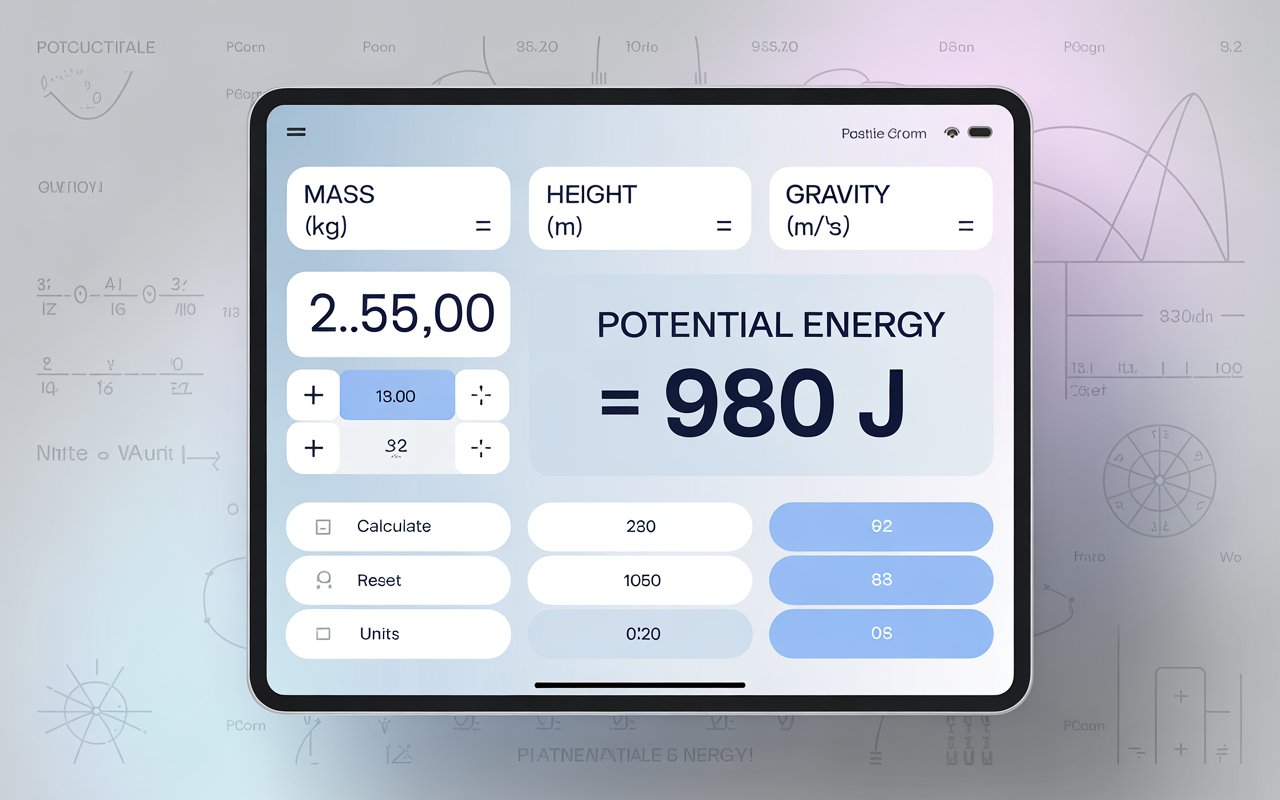
A potential energy calculator isn’t just for students—it’s useful for many industries.
✔ Saves Time
No need to manually calculate formulas.
✔ Reduces Errors
Especially important for engineering and safety applications.
✔ Supports Learning
Helps beginners understand physical concepts easily.
✔ Improves Designs
Engineers can evaluate structures, machines, or energy systems quickly.
✔ Universal Use
From labs to construction sites, it’s a practical tool.
Step-by-Step Guide: How to Use a Potential Energy Calculator
Here’s an easy way to use most calculators:
-
Choose the type of potential energy you want to measure.
-
Enter the object’s mass in kilograms.
-
Input the height or extension depending on the type.
-
Select the gravity constant (Earth, Moon, or custom).
-
Press calculate.
-
Read the output in joules.
That’s it—simple, quick, and accurate.
Common Mistakes and Misunderstandings
Many people misuse potential energy calculators due to a few common errors:
Using wrong units
For example, entering pounds instead of kilograms.
Confusing height with distance
Only vertical height matters—not horizontal movement.
Assuming gravity is always 9.8
Gravity varies slightly depending on location and planet.
Incorrect spring constant
Elastic calculations need precise measurements.
Being aware of these helps ensure accurate results.
Advanced Uses in Science, Engineering, and Tech
Potential energy calculators aren’t only used by students. They’re widely applied in:
Civil engineering
Bridge and building designers measure gravitational loads.
Renewable energy
Hydropower systems rely heavily on water’s stored energy.
Mechanical engineering
Designers of springs, gears, and engines compute elastic potential.
Space science
Gravity varies across planets, so energy calculations differ.
Sports science
Athletes’ movements often involve stored and released energy.
Robotics
Robots must account for load, height, and balance.
These advanced uses highlight how important potential energy calculations are in modern technology.
FAQs
1. What is a potential energy calculator used for?
It helps calculate the amount of stored energy in an object based on mass, height, gravity, elasticity, or charge.
2. Can I use a potential energy calculator for different planets?
Yes. Many calculators allow you to change the gravitational constant to match the Moon, Mars, or custom values.
3. Is potential energy always related to height?
No. While gravitational energy depends on height, elastic, chemical, and electrical potential energies rely on other factors.
4. What unit does a potential energy calculator show?
Most calculators display energy in joules (J).
5. Do I need advanced math to use a potential energy calculator?
Not at all. The calculator does the math for you—just enter the required values.
Final Thoughts
Potential energy is everywhere—quiet, invisible, and powerful. A potential energy calculator makes it easy for anyone, from curious learners to professional engineers, to understand and measure this stored energy.
Using simple formulas and everyday logic, the tool transforms something abstract into something clear and measurable. Whether you’re analyzing a water tank, building a science project, or simply exploring the world of physics, understanding potential energy opens a doorway to seeing the world differently.