







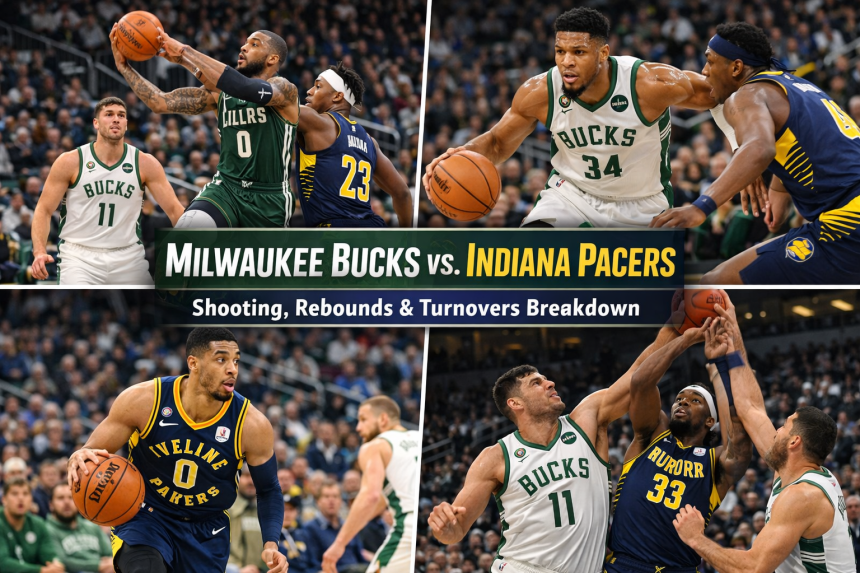
In one of the most compelling Eastern Conference clashes of the season, the Milwaukee Bucks faced off against the Indiana Pacers in a game that revealed important trends in how each team’s stars and role players contributed on both ends of the floor. What stood out most in this matchup were the individual performances in shooting efficiency, rebounds, and turnovers — three statistical pillars that often determine whether a team can walk away with a win or fall short in a tightly contested battle. Using key data from recent box scores and performance summaries of Bucks-Pacers games, this article explores how the match unfolded through numbers that matter most to coaches, fans, and analysts alike.
Sharpshooting and Shooting Efficiency: Who Found Rhythm and Who Didn’t
Shooting efficiency is arguably the most visible measure of offensive success in any NBA game. For the Bucks, this category was influenced heavily by their star wings and big men. In a recent encounter, the Bucks shot over 51% from the field and converted more than 33% of their three-point attempts, displaying both inside scoring and perimeter proficiency. Forward Kevin Porter Jr. led Milwaukee with a hot hand, finishing with 24 points on 8-of-13 shooting while hitting 2-of-3 from beyond the arc. His ability to score efficiently helped the Bucks maintain offensive balance even when some others struggled.
While Milwaukee’s shooting was strong, Indiana’s offensive execution was respectable as well, but not quite at the same level overall. The Pacers were limited to around 40.7% field goal shooting in that matchup, and their three-point efficiency hovered below 26% — a mark that made it difficult for them to sustain scoring runs against Milwaukee’s defense. Despite this, players like Pascal Siakam and Tyrese Haliburton have shown in other games their capacity to shoot efficiently under pressure. Siakam has delivered games with 25+ points on high shooting percentages, and Haliburton’s all-around scoring and playmaking often keep the Pacers competitive.
Across the series, there have also been contests where the shooting was tighter and more closely contested. In an April 19 matchup, the Pacers shot a strong 51.9% from the field and over 38% from three, while the Bucks were limited to 41.7% overall and just 24.3% from deep — evidence that shooting efficiency can ebb and flow dramatically from game to game between these two teams.
For the Bucks, players like Brook Lopez and Giannis Antetokounmpo have often been focal points in efficient shooting distribution. In a March meeting with Indiana, Lopez posted 23 points on 9-of-11 shooting, while Giannis scored efficiently with 9-of-14 from the field. Even Damian Lillard, though less efficient that night, still contributed with assists and secondary scoring. These stars’ efficiency directly affects the Bucks’ offensive rhythm and spacing, especially when the team’s role players aren’t hitting shots consistently.

The Boards Matter: Rebounding Battles and Their Impact
Rebounding is another area where the Bucks and Pacers have engaged in intriguing battles. Effective rebounding often determines second-chance opportunities and limits opponents’ scoring from offensive rebounds, a key factor in momentum shifts.
In the December matchup where Milwaukee shot with high efficiency, the team also pulled down 55 total rebounds compared to Indiana’s 53. That slight edge on the boards helped Milwaukee control possessions and reduce second-chance points for the Pacers. Bigs like Bobby Portis and their frontcourt combinations played meaningful roles in securing defensive rebounds and sparking transition opportunities.
Across other recent games, Giannis Antetokounmpo’s presence on the glass has loomed large. In one contest earlier in the season, Giannis grabbed 13 rebounds to go with his 33 points, anchoring the Bucks’ interior presence on both ends of the court. In that same game, the rebounding battle was nearly even — another indicator that boards can swing either way depending on matchups and rotations.
For the Pacers, frontcourt contributors like Myles Turner and Aaron Nesmith have anchored many of the team’s rebounding efforts. Turner, in particular, has shown he can dominate the glass even when his scoring output isn’t as prolific, posting double-figure rebounds in several matchups. This allows Indiana to limit transition opportunities for Milwaukee and maintain closer scorelines — an essential ingredient in their tight contest wins. While rebounding hasn’t been decisively one-sided, the subtle efficiency in winning more contested boards has helped Pacers claw back in games where their shooting was less consistent.
Turnovers: Taking Care of the Ball vs. Forcing Mistakes
Turnovers represent the crossroads of offense and defense — they reflect offensive discipline while also providing opportunities for opponents to score in transition. In recent Bucks-Pacers games, turnovers proved decisive.
In the December game where Milwaukee won 111-94, the Bucks committed 15 turnovers, while the Pacers had 12. Despite this margin, Milwaukee’s overall offensive output was able to absorb those mistakes, but turnovers still limited scoring efficiency and possession control. Pacers star Ryan Rollins, for instance, was responsible for several turnovers — an area he would need to refine to be more consistently impactful.
In another matchup earlier in the season, the Pacers beat the Bucks while forcing Milwaukee into 15 turnovers compared to their 10 turnovers. Those extra possessions converted into points off turnovers helped Indiana secure a narrow win. Carelessness with the ball disrupts offensive spacing and can lead to quick breaks for the opponent — a common theme in close games between these two franchises.
When examining turnover trends over several games, it becomes clear that both teams emphasize ball security differently depending on roster availability and game flow. Milwaukee’s stars typically value possession control but have had games — particularly when role players fill larger scoring roles — with higher turnover rates. Indiana, on the other hand, has often balanced aggressive defense with careful ball movement, leveraging Haliburton’s vision to generate scoring while avoiding unforced errors. Ultimately, turnovers can heavily influence field goal attempts, pace of play, and overall rhythm for both offenses.
Individual Standouts: Breaking Down Key Performances
While team aggregates are important, narratives in NBA matchups often hinge on individual performances that shift momentum.
On the Bucks side, Giannis Antetokounmpo remains a perennial force. Across multiple games against Indiana, he has shown the ability to score efficiently inside the paint, rebound at a high clip, and facilitate offense. In one highlighted contest, Giannis logged 36 points and 12 rebounds, illustrating his continued dominance in scoring efficiency and board control.
Role players like Kevin Porter Jr. and Ryan Rollins have also had major impacts. Porter’s three-point shooting and mid-range scoring have diversified Milwaukee’s offensive threats, while Rollins’ scoring spurts keep defenses honest. When these secondary scorers find shooting rhythm, the Bucks’ offense becomes significantly harder to defend.
For the Pacers, Pascal Siakam and Haliburton have led the charge. Siakam’s scoring efficiency — often shooting well above 50% from the field — gives Indiana a reliable inside-out scoring balance. Haliburton’s ability to create shots for himself and teammates via assists increases that scoring efficiency and keeps the Pacers competitive even when their overall team shooting slips. In one close win, Haliburton scored 14 points and grabbed 10 rebounds, showcasing his all-around value.
Other Pacers contributors, such as Bennedict Mathurin and T.J. McConnell, have fluctuated from game to game, but often provide critical scoring bursts off the bench. Their efficiency — or lack thereof — can be a telling barometer for Indiana’s offensive success in any given matchup with Milwaukee.
What These Stats Mean for Future Matchups
When looking at shooting efficiency, rebounds, and turnovers collectively, a clear pattern emerges. Milwaukee tends to thrive when they combine high efficiency with controlled possessions and strong rebounding, while Indiana remains competitive when their key scorers shoot effectively and the team minimizes turnovers while maximizing possessions off the glass. Winning these statistical battles has often translated directly into wins.
For fans, these trends help explain why certain games are close, while others see one team dominate. Shooting efficiency is the most variable — teams can explode one night and struggle the next — but rebounding and turnover management remain more stable predictors of overall performance. Observing how each squad adjusts rotations, strategies, and defensive focus based on these stats will be crucial for upcoming games between these conference rivals.